
How Listing Your Business Drives Real Growth
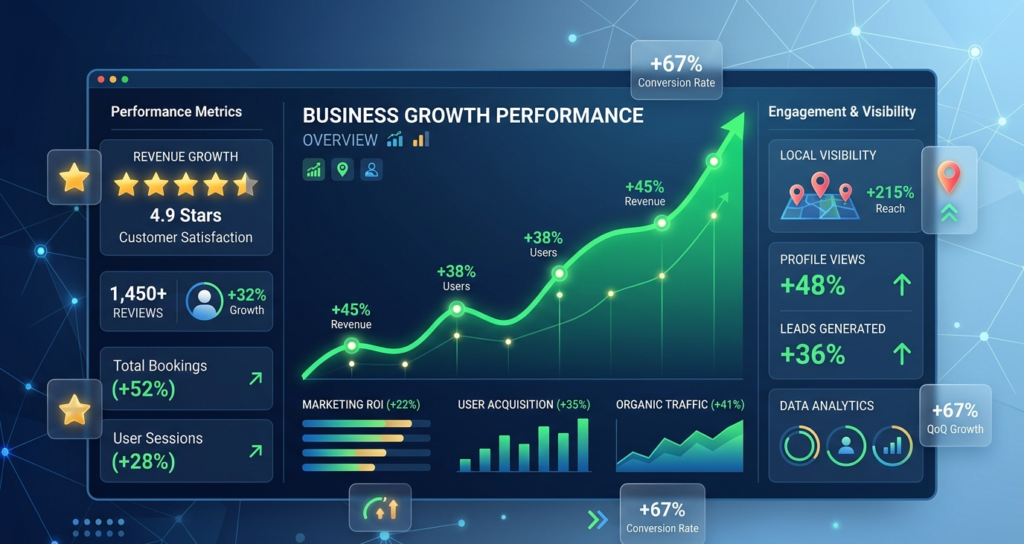
Most business owners think of “listing” as a checkbox. Claim the Google profile, maybe update Yelp, move on. But listing, whether on a search directory or a stock exchange, is one of the most reliable growth levers that exists. And the data backs it up across every market on the planet.
The logic is identical at both ends of the spectrum. A local plumber without a Google Business Profile is invisible to the 97% of consumers who search online before calling anyone. Similarly, a high-growth company without a stock exchange listing is invisible to the institutional investors, pension funds, and ETFs that hold the deepest pools of capital on earth. Listing solves a single problem at every scale: it makes the invisible findable.
Online listings are quietly printing money
Here’s what most people get wrong about directory listings. They treat them as static. Fill in the name, address, phone number, and forget it. Meanwhile, their competitors are generating three-to-one returns on directory investments, and local service businesses like electricians and cleaners are pulling eight-to-one.
The numbers tell a clear story. According to BrightLocal’s 2025 local SEO data, 46% of all Google searches carry local intent, and 93% of those trigger the Map Pack. Yet only 35% of small businesses have even claimed a Google Business Profile. That gap between supply and demand is where the growth sits.
Businesses that do optimise their profiles see immediate results. Verified, complete profiles appear 80% more often in search results. They generate four times more website visits, 12% more phone calls, and 10% more direction requests than incomplete ones. On top of that, 76% of people who search for a local business visit within 24 hours, and 28% of those searches end in a purchase. Compare that to the 2-3% conversion rates of most online advertising, and the ROI case writes itself.
Reviews run the show now
However, simply having a listing is no longer enough. Reviews have become the real currency of consumer trust. Around 98% of consumers read online reviews at least occasionally, and 41% say they always check reviews before choosing a business. That figure jumped from 29% just a year earlier.
Star ratings directly control whether someone clicks or scrolls past. Moving from three stars to five earns 25% more clicks from Google’s Local Pack. Conversely, only 3% of consumers would even consider a business with two stars or fewer. Volume matters too. Reaching 100 reviews drives a 37% increase in conversions, while every 10 new reviews improve Google Business Profile conversion by 2.8%.
What separates good operators from everyone else is responsiveness. About 88% of consumers would use a business that replies to all its reviews. Only 47% would use one that ignores them. Negative reviews responded to within 24 hours are 33% more likely to be revised upward by the original reviewer. So the review game rewards attention, not perfection.
Consistency across platforms compounds the effect
Beyond any single platform, keeping your business name, address, and phone number (NAP) consistent across directories has an outsized impact on rankings. Businesses with consistent NAP data across major citation sources are 40% more likely to appear in Google’s Local Pack. Meanwhile, 62% of consumers will avoid a business entirely if they find incorrect information online.
For multi-location brands, the effect multiplies. Fully optimised brands achieve 65.7% visibility in Google’s 3-pack for competitive keywords. That’s nearly double the 33.4% average for brands that haven’t cleaned up their listings.
It’s also worth noting that Google isn’t the only game globally. Baidu holds over 52% search share in China. Yandex commands 68-76% in Russia. Naver controls 42.3% in South Korea. A truly global listing strategy means optimising for the platforms that dominate each market, not just Google.
IPO listings: the same logic, different scale
While a Google listing connects a business to local customers, a stock exchange listing connects it to global capital. And the growth impact is just as measurable.
According to EY’s 2025 Global IPO Trends, 1,293 companies went public globally in 2025, raising $171.8 billion in total. That marked a 39% increase in proceeds over 2024, driven by larger, higher-quality deals.
The geography shifted too. Hong Kong reclaimed the global IPO crown for the first time since 2019, raising $34.3 billion from around 114 IPOs. India contributed 367 IPOs worth $22.9 billion. The U.S. posted 216 IPOs at $47.4 billion, up 38% in proceeds year over year.
Beyond capital, the valuation bump alone justifies the effort. An analysis of 103 venture-backed U.S. IPOs found a median 1.88x valuation increase from the last private round to IPO pricing. Pre-IPO valuations of $2.7 billion jumped to roughly $5.0 billion at listing.
Still, IPOs carry real costs and risks. Underwriting fees run 4-7% of gross proceeds, with total upfront costs ranging from $4-10 million. Annual compliance adds another $1-2.5 million. Roughly two-thirds of IPOs underperform the broader market within three years. Zomato lost 70% of its market cap within six months of listing in 2021 before executing a dramatic turnaround that made it one of India’s top 50 most valuable companies.
The takeaway for every business owner
Whether you’re claiming a free Google profile or considering an IPO, the underlying principle is the same. Visibility creates trust. Trust creates access. Access creates growth.
For local businesses, the action is immediate and free: claim your profiles, complete every field, generate reviews, respond to every one of them, and keep your data consistent across platforms. For growth-stage companies, the IPO conversation demands preparation, but the payoff in capital, talent acquisition, M&A currency, and brand credibility compounds for years.
The businesses that list well, grow. The ones that stay invisible, don’t. That part hasn’t changed.
Bylined Article By Jesse Fowler
Founder, Plumber, J & J P